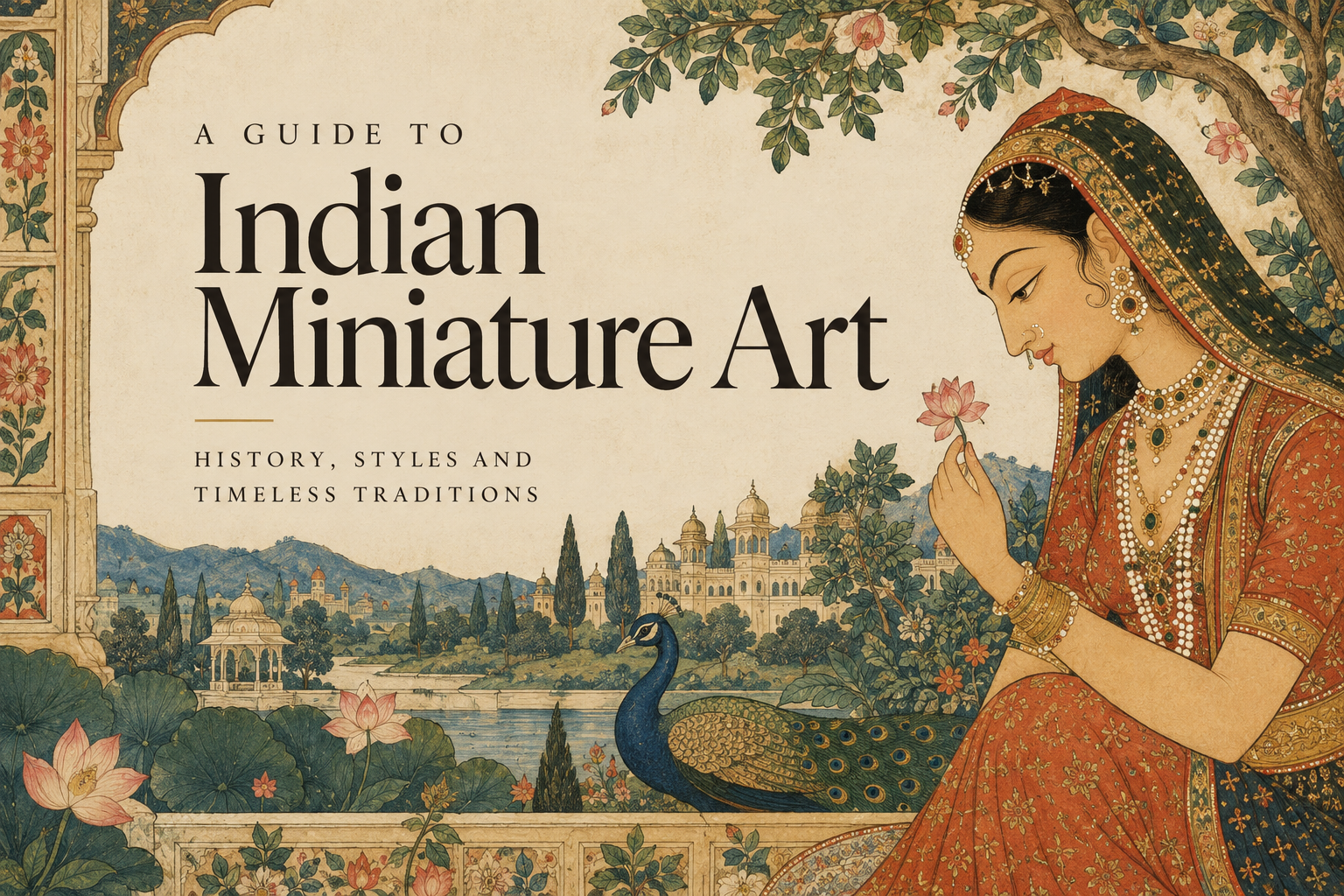
Indian miniature painting is one of the most refined and fascinating traditions in the history of Indian art. Known for its intricate details, vibrant colours, delicate brushwork, and storytelling, miniature paintings have preserved stories of royalty, religion, mythology, nature, love, music, and everyday life for centuries.
Far from being simply “small paintings,” Indian miniatures are a sophisticated visual language shaped by different kingdoms, regions, religions, and artistic traditions.


4
What Is Indian Miniature Art?
Indian miniature painting refers to paintings created on a relatively small scale using extremely fine brushes and detailed techniques. Historically, artists often worked with natural pigments, mineral colours, gold, silver, and handmade paper or other carefully prepared surfaces.
The word “miniature” refers primarily to the scale and detailed technique, rather than a single artistic style.
This distinction is important because there is no one “Indian miniature style.” Instead, miniature painting developed into numerous schools across the Indian subcontinent.
Artists created paintings depicting:
Hindu gods and religious stories
Mughal emperors and royal courts
Battles and historical events
Lovers and romantic poetry
Musicians and dancers
Animals and birds
Landscapes and gardens
Festivals and everyday life
Scenes from epics such as the Ramayana and Mahabharata
A Brief History of Indian Miniature Painting
The roots of Indian miniature painting can be traced back to the illustrated manuscript traditions of Buddhist, Jain, and Hindu communities.
Early illustrated manuscripts were particularly important in western India. Jain monks and patrons commissioned richly decorated manuscripts containing religious texts, with paintings illustrating important stories and figures.
From the 16th century onward, miniature painting developed dramatically under the influence of different royal courts.
The Mughal Empire played a particularly important role in the evolution of Indian miniature painting. Mughal rulers brought together Persian artistic traditions with Indian techniques and subjects, creating a distinctive courtly style.
Later, as Mughal political power declined, artists travelled to regional courts. This movement helped miniature painting flourish in places such as Rajasthan, the Punjab Hills, central India, and the Deccan.
The result was a remarkable variety of regional schools.
Major Types of Indian Miniature Painting
1. Mughal Miniature Painting


Mughal miniature painting developed in the imperial courts of the Mughal emperors, particularly during the reigns of Akbar, Jahangir, and Shah Jahan.
The Mughal style was strongly influenced by Persian miniature painting but gradually developed a distinctly Indian character.
Characteristics
Highly detailed portraits
Realistic depiction of people and animals
Elaborate costumes
Court scenes
Battles and historical events
Detailed architecture
Gardens and landscapes
Fine use of gold
Sophisticated perspective and composition
Akbar's period was particularly important because large illustrated manuscripts were produced in royal workshops.
Under Jahangir, artists became increasingly interested in naturalistic observation. Birds, animals, flowers, and portraits were rendered with remarkable precision.
The Mughal tradition therefore occupies an important place in the history of Indian painting because of its combination of Persian refinement, Indian subject matter, and increasingly naturalistic observation.
2. Rajasthani Miniature Painting


Rajasthani miniature painting developed across the many Rajput courts of Rajasthan.
Unlike Mughal paintings, which frequently focused on imperial court life and historical documentation, many Rajasthani schools placed greater emphasis on Hindu mythology, devotion, romance, and poetry.
Important schools include:
Mewar
Marwar
Bundi
Kota
Jaipur
Bikaner
Kishangarh
Common subjects
One of the most popular subjects was the divine love of Radha and Krishna.
Artists also depicted:
Krishna's childhood
Hindu deities
Ramayana
Mahabharata
Ragamala paintings
Royal portraits
Hunting scenes
Festivals
Romantic scenes
Rajasthani paintings are often recognised by their strong colours, expressive figures, decorative landscapes, and lyrical compositions.
3. Pahari Miniature Painting


The Pahari school developed in the Himalayan foothills, particularly in the small kingdoms of present-day Himachal Pradesh and Jammu.
The word Pahari essentially means "of the hills."
Important schools include:
Basohli
Guler
Kangra
Chamba
Kullu
Mandi
The Kangra school is especially famous.
Kangra Painting
Kangra paintings are known for their graceful figures, delicate colours, lush landscapes, and romantic themes.
Radha and Krishna appear frequently, often surrounded by:
Green forests
Rivers
Mountains
Flowering plants
Moonlit landscapes
Compared with the stronger visual intensity of some Rajasthani paintings, Kangra works often have a softer and more lyrical quality.
4. Deccan Miniature Painting


Deccani miniature painting developed in the courts of the Deccan Sultanates.
Important centres included:
Bijapur
Golconda
Ahmadnagar
Hyderabad
Deccani paintings are particularly distinctive because of their rich colours and luxurious visual language.
Characteristics
Brilliant colours
Extensive use of gold
Stylised figures
Elaborate clothing
Decorative backgrounds
Dreamlike landscapes
Persian and Indian influences
Artists often depicted rulers, nobles, musicians, lovers, and fantastical landscapes.
The Deccan tradition demonstrates how Indian miniature painting was shaped not only by northern imperial courts but also by powerful artistic centres in southern and central India.
5. Malwa Miniature Painting


The Malwa school developed in central India.
Its paintings are often recognised by their flat compositions, bold colours, geometric architecture, and simplified figures.
Compared with the naturalistic Mughal tradition, Malwa paintings can appear deliberately stylised.
Themes included:
Hindu mythology
Krishna and Radha
Ragamala
Religious stories
Romantic narratives
The visual simplicity of Malwa paintings gives them a distinctive character within the broader miniature tradition.
6. Company Painting


During British colonial rule, a new hybrid style emerged known as Company painting.
Indian artists created works for British officials, travellers, collectors, and administrators.
The paintings often documented:
Indian monuments
Plants and animals
Occupations
Festivals
People from different communities
Architecture
Landscapes
European ideas of realism, perspective, and natural history influenced these works.
Company painting is therefore important because it represents a period when Indian artistic traditions interacted directly with European visual culture.
7. Jain Miniature Painting


Jain miniature painting represents one of the earliest and most important traditions of Indian manuscript illustration.
Many works were created to illustrate Jain religious texts, particularly manuscripts of the Kalpasutra.
Characteristics
Strong red and yellow backgrounds
Stylised human figures
Large, prominent eyes
Decorative borders
Religious narratives
Highly symbolic compositions
These paintings were not simply decorative. They served a religious and educational purpose, helping communicate sacred stories and teachings.
8. Buddhist Miniature Painting


One of the earliest traditions associated with Indian miniature painting developed around Buddhist manuscript illustration.
The Pala period, particularly in eastern India, produced important illustrated Buddhist manuscripts.
These works commonly depicted:
Buddha
Bodhisattvas
Buddhist deities
Religious narratives
The tradition later influenced Buddhist art in regions such as Nepal and Tibet.
9. Ragamala Paintings


Ragamala painting is a fascinating category within Indian miniature art.
The word Ragamala means "garland of ragas."
Indian classical music associates particular ragas with emotions, seasons, times of day, and moods. Artists translated these musical concepts into visual scenes.
For example, a painting might represent:
A woman waiting for her lover beneath a stormy sky.
The scene isn't merely a romantic image. It visually represents the emotional world associated with a particular musical mode.
This creates an extraordinary connection between music, poetry, emotion, and painting.
The Common Materials Used
Traditional miniature artists worked with carefully prepared materials.
Surfaces
Handmade paper
Palm leaf
Cloth
Manuscript pages
Pigments
Historically, artists used naturally derived pigments from:
Minerals
Plants
Flowers
Stones
Metals
Gold and silver were also used to add luminosity and decoration.
Brushes
Extremely fine brushes allowed artists to create tiny details such as:
Individual hairs
Jewellery
Facial features
Leaves
Feathers
Textile patterns
This extraordinary attention to detail is one of the defining qualities of miniature painting.
What Makes Indian Miniature Painting Special?
Indian miniature painting is remarkable because it combines scale with complexity.
A painting may be only a few inches wide, yet contain an entire narrative.
A single artwork can include:
Characters → architecture → landscape → animals → costumes → music → mythology → symbolism
All within a small surface.
Another important characteristic is that miniature painting was never a single, fixed style.
It evolved as artists moved between courts and communities, absorbing different influences.
Persian traditions interacted with Indian painting.
Mughal naturalism interacted with Rajput devotional traditions.
European realism influenced Company painting.
Local landscapes influenced Pahari artists.
Religious traditions shaped Jain and Buddhist manuscripts.
This constant exchange created the extraordinary diversity we now associate with Indian miniature art.
Indian Miniature Painting Today
Indian miniature painting continues to influence contemporary artists and designers.
Artists today reinterpret traditional techniques and subjects while experimenting with:
Contemporary themes
Modern compositions
New materials
Mixed media
Digital art
Contemporary storytelling
The tradition therefore isn't simply something preserved in museums. It continues to evolve.
More Than Small Paintings
Indian miniature art is ultimately a record of India's cultural imagination.
Through these tiny paintings we can see how different communities understood:
love, devotion, power, nature, music, spirituality, beauty and everyday life.
From the imperial workshops of the Mughals to the hills of Kangra, the courts of Rajasthan, the Deccan Sultanates and Jain manuscript traditions, each school developed its own visual vocabulary.
What makes Indian miniature painting particularly fascinating is that the smaller the canvas, the larger the world it can contain.