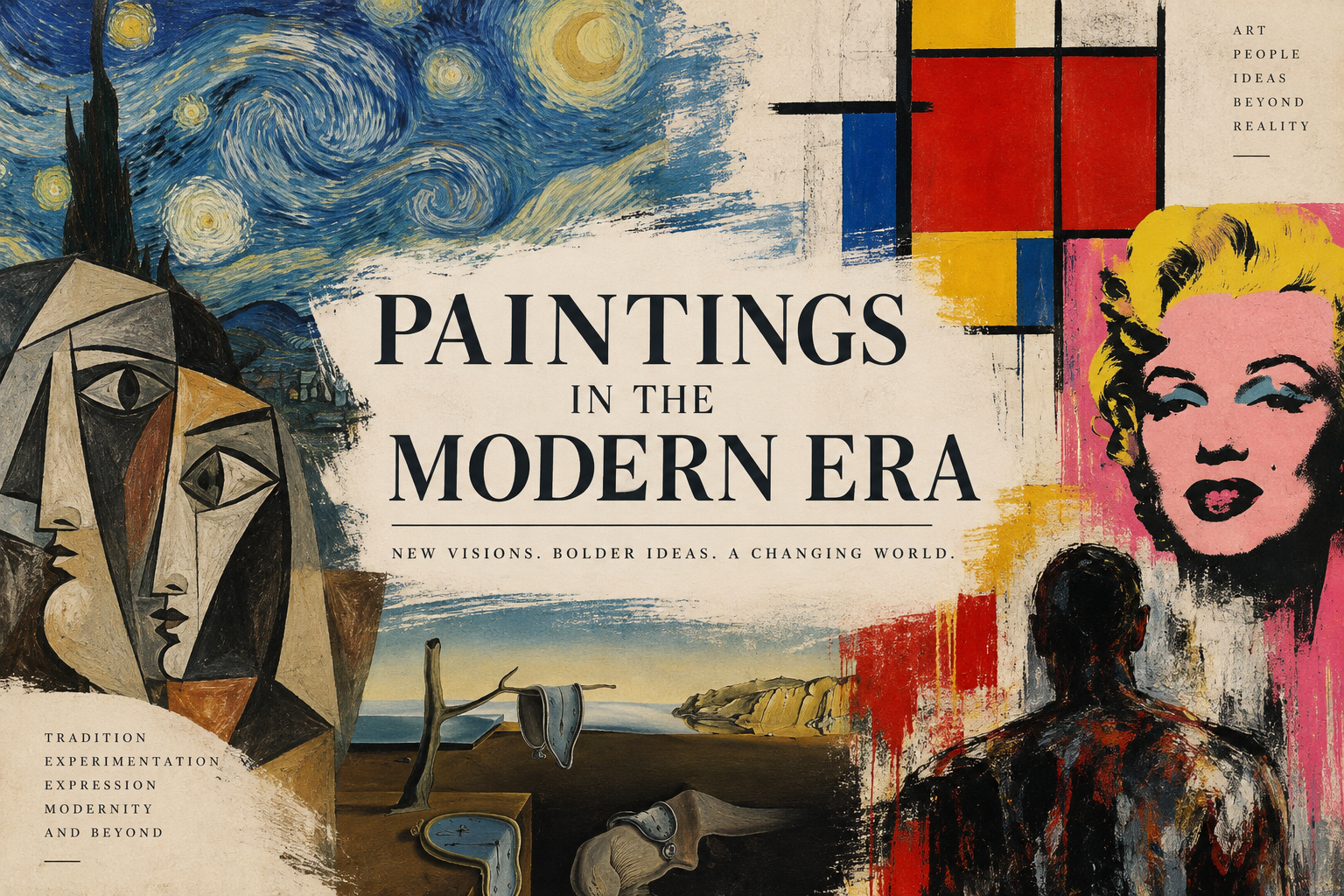
Painting has always been a powerful form of human expression. From the earliest drawings on cave walls to the elaborate works of the Renaissance, artists have used paintings to record history, express emotions, and interpret the world around them. However, the **modern era brought a dramatic transformation to painting**. Artists began to move away from traditional rules and realistic representation, experimenting instead with color, form, emotion, abstraction, and new ideas.
The modern era of painting is generally associated with the period from the **late 19th century through much of the 20th century**. It was a time of enormous social and technological change. Industrialization, urbanization, photography, world wars, political movements, and new scientific ideas all influenced the way artists viewed the world.
The Beginning of Modern Painting
Modern painting emerged partly as a reaction against the strict academic traditions that had dominated European art for centuries. Traditionally, artists were expected to produce realistic paintings, often based on historical, religious, or mythological subjects. During the 19th century, however, artists increasingly began to challenge these expectations.
The **Impressionists**, including Claude Monet, Pierre-Auguste Renoir, and Edgar Degas, played an important role in this transformation. Instead of carefully reproducing every detail, they attempted to capture light, atmosphere, movement, and the fleeting experience of a particular moment. Their loose brushwork and unusual compositions initially shocked many viewers but eventually became highly influential.
The Rise of New Artistic Movements
The modern era was characterized by a remarkable number of artistic movements. Each movement questioned established ideas and introduced new ways of creating and understanding art.
**Post-Impressionism** pushed the experiments of Impressionism further. Artists such as Vincent van Gogh, Paul Cézanne, and Paul Gauguin developed distinctive approaches to color, structure, and emotion. Van Gogh, for example, used energetic brushstrokes and intense colors to communicate his emotional response to the world.
**Cubism**, developed by Pablo Picasso and Georges Braque, radically changed the representation of objects. Instead of showing an object from a single viewpoint, Cubist artists presented multiple perspectives simultaneously, breaking subjects into geometric forms.
**Expressionism** placed greater emphasis on emotion than realistic appearance. Artists deliberately distorted shapes and used intense colors to communicate feelings such as anxiety, loneliness, excitement, or fear.
**Surrealism**, associated with artists such as Salvador Dalí and René Magritte, explored dreams, the unconscious mind, and irrational combinations of objects. Surrealist paintings often presented familiar things in strange and unexpected situations.


## Abstract Art
One of the most significant developments of modern painting was **abstraction**. Abstract artists moved further away from representing recognizable people, objects, and landscapes. Instead, they used shapes, lines, colors, and patterns as independent elements.
Artists such as **Wassily Kandinsky**, Kazimir Malevich, and Piet Mondrian believed that painting could communicate ideas and emotions without depicting the physical world. Mondrian's geometric compositions, for example, reduced visual elements to simple lines and blocks of color.
Abstract art changed the fundamental question of what a painting could be. A painting no longer necessarily had to represent something recognizable; it could simply create a visual and emotional experience.
## The Influence of Technology and Photography
Photography had a major impact on modern painting. Once cameras became increasingly capable of recording realistic images, painters were no longer the primary means of visually documenting people and events.
This gave artists greater freedom to explore subjects that photography could not easily express. Painting increasingly became a medium for **interpretation rather than simple representation**.
At the same time, technological developments introduced new materials, pigments, printing methods, and eventually digital tools. Artists could experiment with materials and techniques that earlier generations had never had access to.
## Modern Painting Beyond Europe
Although many major modern art movements developed in Europe, modern painting was not limited to the Western world. Artists across Asia, Africa, Latin America, and other regions responded to modernity in their own ways.
In **India**, the development of modern painting was closely connected with colonialism, nationalism, and the search for a modern Indian identity. Artists such as **Amrita Sher-Gil**, M. F. Husain, S. H. Raza, and F. N. Souza explored different combinations of Indian subjects, traditions, and international modernist ideas.


Amrita Sher-Gil, for instance, combined influences from European modernism with subjects drawn from Indian life. Her paintings of Indian people and rural communities demonstrated how modern art could engage with local experiences rather than simply imitate European traditions.
## Painting After the World Wars
The two World Wars profoundly affected artists and society. After the Second World War, the center of the international art world shifted increasingly toward the United States, particularly New York.
**Abstract Expressionism** became an important movement during this period. Artists such as Jackson Pollock and Mark Rothko emphasized spontaneous gestures, large-scale compositions, color, and emotional intensity.
Pollock became famous for his "drip painting" technique, in which paint was poured, dripped, or splattered onto large canvases. Rothko, in contrast, created large fields of color designed to produce a contemplative emotional experience.
Later movements such as **Pop Art** challenged the distinction between popular culture and fine art. Artists including Andy Warhol incorporated images of celebrities, advertisements, consumer products, and mass-produced media into their work.


## Painting in the Contemporary World
Today, painting continues to evolve. Contemporary artists are not restricted to one particular style or philosophy. Some create highly realistic paintings, while others work with abstraction, conceptual art, mixed media, or digital technology.
Globalization has also changed the art world. Artists can now encounter artistic traditions from different cultures almost instantly through museums, exhibitions, books, social media, and the internet. This has created greater interaction between artistic traditions.
Digital technology has also expanded the possibilities of painting. Digital artists can create images using tablets and specialized software, while artificial intelligence and other emerging technologies are creating new discussions about authorship, creativity, and the definition of art.
Nevertheless, traditional painting remains important. Oil, acrylic, watercolor, and other physical media continue to be used by millions of artists.
## Conclusion
Paintings in the modern era represent a fundamental transformation in the history of art. Artists gradually moved away from the idea that painting had to follow established rules or accurately reproduce reality. Instead, they explored **emotion, individual expression, abstraction, perception, politics, popular culture, identity, and new technology**.
From Impressionism and Cubism to Surrealism, Abstract Expressionism, Pop Art, and contemporary practices, modern painting demonstrates that art changes alongside society. The greatest achievement of modern painting may not be a particular style or movement, but the expansion of the possibilities of artistic expression.
In the modern era, a painting can represent reality, distort it, question it, or abandon representation altogether. What matters is the artist's ability to use visual language to communicate an idea, experience, or emotion.